Three different reasons a run ends
Almost every fall in the browser build gets filed under "I messed up". That label is useless, because it hides which of three things went wrong. The same landing can come from a release that was too early, an approach that never lined up with the bar, or a body position that made the flight unusable. Each one has a different fix, and guessing costs you more attempts than it saves.
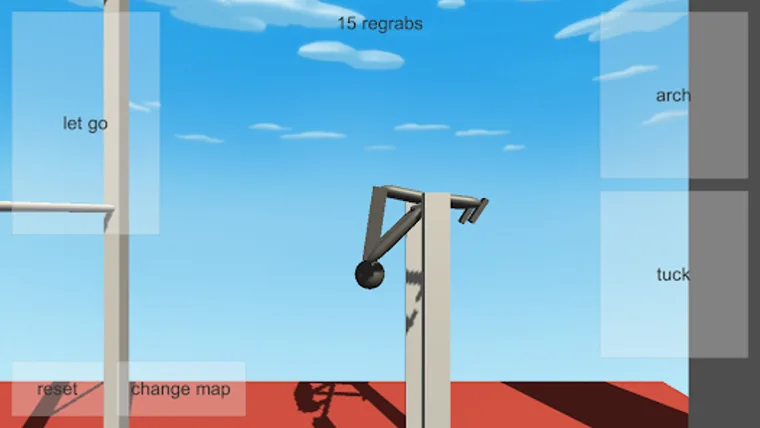
The screenshot on this page is the mobile touch layout, where the four action zones sit next to a reset zone and a change-map zone. Everything below describes the classic browser build, which is documented as four keyboard inputs: Left Arrow to arch, Space to tuck, Up Arrow to let go and R to reset. There is no documented grab, twist or map-change key in that build.
| What you saw | Which kind of fall | Where to look |
|---|---|---|
| The gymnast left the bar travelling away from the next one | Release | The point where you pressed Up Arrow. |
| The flight was fine but the body was wrong at the bar | Body position | Your arch and tuck order during the swing. |
| The flight was short no matter when you released | Approach | The swing you built before the release. |
Falls caused by the release
A release fall is the most common, and the easiest to diagnose because the cause happens at a single moment. You pressed Up Arrow, and from that instant the path is decided by where you were in the swing and how fast you were moving.
- Travelled away from the bar. The release came at a point where the gymnast was already heading back the way they came. Try releasing earlier in the arc and compare the first second of flight.
- Fell short every time. The release looked reasonable from the bar, but there was not enough travel left in the arc. Try a slightly later release from the same setup.
- Inconsistent in both directions. The swing itself is not repeatable yet, so the release inherits that variation. Fix the swing before touching the release.
To confirm a release fall before you fix it, hold everything else steady: same start, same input order, same marker, ten attempts. A release fall repeats. The gymnast travels away from the bar again and again in roughly the same direction, which is what makes it recognisable. If the direction scatters across attempts, you have an approach problem wearing a release problem's clothes.
The release timing guide walks through the earlier-versus-later comparison in more detail, and the common mistakes guide covers what happens when the release point moves on every attempt.
Falls caused by the approach
An approach fall looks like a bad release from a distance, but the release was fine. The gymnast simply was not where you needed them to be when you let go, because the swing into the bar never repeated. You cannot fix this by pressing Up Arrow earlier or later, because the starting point of the attempt is the problem.
What to look for: the swing varies between attempts even when your inputs are identical, or the swing that produced a good flight cannot be produced again. The fix is boring. Make the smallest swing you can hit five times in a row, then release at a fixed marker every attempt. Once the flight paths match each other, changing the release becomes meaningful, because the only variable left is the release itself. The swing timing drill is built for exactly this step.
Falls caused by body position
Here the path is right and the gymnast arrives somewhere unhelpful. You released correctly and reached roughly the right area, but the body was extended, tucked or twisted in a way that turned the flight away from the bar. The release is not your problem in this case, and adjusting it will make things worse.
Two things cause this in practice. The first is holding a key rather than making a single press, so the input reads differently from attempt to attempt. The second is changing arch and tuck in the same swing, so the order you received was never the order you planned. Fix both by making one deliberate input per swing and resetting with R between attempts. Once the body position is consistent, a fall that still arrives in a bad shape is genuinely about the release, and you can move it without chasing two variables at once. If you want the shape of a flight that gets you into trouble, the flips guide explains how added rotation changes the result after the release.
Reading a fall after it happens
| Symptom | Likely cause | Try this |
|---|---|---|
| Fell forward, away from the next bar | Release point | Release one notch earlier from the same swing. |
| Fell short with the right body shape | Release point | Release one notch later from the same swing. |
| Path changed shape on every attempt | Body position | Hold release steady, change one arch or tuck input. |
| Every attempt differs before the release | Approach | Reset and rebuild the smallest repeatable swing. |
| You never saw where it went wrong | Attention | Watch the first second of flight, not the landing. |
| Keys stopped responding after switching windows | Page focus | Click back into the game area, then try Left Arrow. |
Write the row down after the attempt, not after ten attempts. A fall you cannot describe is a fall you cannot fix, and the description is most of the work.
Practising recovery before you need it
The habit worth building is the one that runs between the fall and the next attempt. Start with a fixed routine:
- Let the gymnast reach the floor. Do not press R mid-air; it resets the run and removes the end of the attempt you wanted to see.
- Say one sentence about the fall: which of the three kinds it was, and what you saw first.
- Press R, return to the same setup, and change exactly one thing.
- Run three attempts on that change before deciding whether it helped.
Practise this on purpose. Take a release you know is slightly early, take the resulting fall, and walk through the routine without changing the outcome. A routine you have never used during a real miss is a routine you will not use during one.
On the mobile apps the same routine is shorter, because the touch layout puts a reset zone beside the four action zones and shows a regrab count at the top of the screen. That layout comes from the store listings rather than the browser build; the version comparison covers the differences.
What recovery cannot fix
Some falls are not technique problems, and repeating the routine will not move them.
- Keys that do nothing. If Space scrolls the page instead of tucking, the canvas does not have focus. That is not a fall; it is an interrupted session.
- A late-feeling release. If the same input produces noticeably different results on different attempts, the timing itself is moving. The input timing guide covers calibrating a release by comparison.
- A run that never starts. If the player stays black or the loading bar hangs, nothing about your technique matters yet. Work down the browser fix list first.
Once those are ruled out, return to the swing drill and rebuild from something small. The first session guide is a reasonable starting point if you are starting over, and the guide library lists the rest in order.
Frequently asked questions
Why do I fall in NoomiClone?
There are three different reasons a run ends: the release was wrong, the approach was wrong, or the body position in the air was wrong. They look identical on screen, which is why separating them is the first job the guide does.
How do you recover from a fall in NoomiClone?
Practise the recovery before you need it. The guide separates recovery routines for the three kinds of fall so that when a run ends you already know which one it was and what to change on the next attempt.
Can you fix a bad NoomiClone run without resetting?
Sometimes, and the guide is explicit about the limit. Some falls are recoverable by a different body position in the air; others are a release that cannot be rescued. Knowing which case you are in is what stops you chasing a ruined attempt.
Sources and scope. Browser key bindings and mobile feature descriptions were checked against the developer's browser listing, Google Play and App Store on October 19, 2026. Practice drills are independent editorial suggestions. Game screenshot provenance is documented in About & sources.