What letting go actually changes
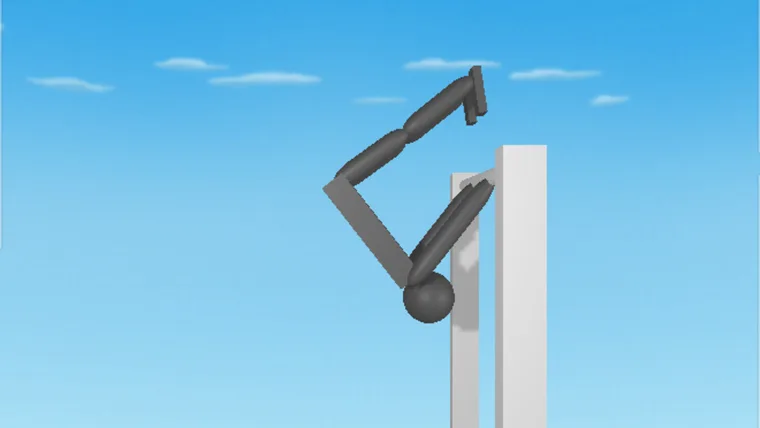
Pressing Up Arrow does not aim the gymnast. It ends the swing and hands whatever motion you had to the air. Everything your flight does afterwards — how high you go, how far forward you travel, which way the body is pointing when you get there — comes from the position and the direction you were moving at the moment you let go.
That is why release timing feels fussy. You are not adjusting a setting; you are choosing a starting point for a movement you cannot steer once it begins. A slightly earlier release means the body was travelling along a different part of the pendulum arc, at a slightly different angle, so the airborne path starts somewhere else even though the inputs look identical.
This page treats release timing as something you can read rather than something you can memorise. The comparison method is a practice suggestion. There are no fixed numbers to memorise here, because the game does not publish any.
There is no grab key to aim with
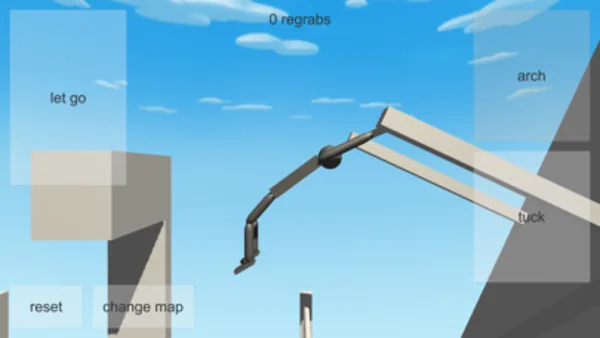
The classic browser build documents four inputs and only four: Left Arrow to arch, Space to tuck, Up Arrow to let go, and R to reset.
Worth saying plainly, because this is the assumption that trips up new players: there is no documented grab key, no twist key and no map-change key in the browser listing. You cannot press a button to grab the next bar. The catch happens because the flight path and the body position line up with the bar, not because you selected it.
So "aiming" a release is a matter of choosing a moment and a shape. If you want a proper look at the keys themselves, the controls guide lists all four.
Mid-flight is where the answer shows
The moment right after release is the most informative part of the attempt and the part players watch least. Look at three things in order:
- Which way the body is angled — pointed along the direction of travel, leaning back, or head-down.
- Whether it is rising or already falling when it clears the bar it left.
- Whether it drifts toward the next bar or away from it while still high.
If you can catch those three in order, you can describe your own flight out loud, and describing an attempt is the first step towards changing it deliberately.
Early, on time, late
The reliable way to learn release timing is comparison, not repetition of one guess. Build a swing you can already repeat — if you cannot, use the swing timing drill first — then make three releases from that same swing:
- Early. Let go before your usual point, while the swing is still travelling upward or near its highest point.
- On time. Release at the moment that usually works. Treat this as your reference line.
- Late. Hold on further along and let go as the body comes back down.
Reset with R between each so the swing rebuilds the same way. Compare the three paths in the same order every time: where the body points, how high it gets, and how close it comes to the next bar.
Most players find one of three outcomes, and the outcome tells them what to work on next:
- Early is always higher but lands short. You are giving up forward travel. Try releasing slightly later, from a lower point in the swing.
- Late is always further but drops early. You are travelling well but arriving with nothing left. Try releasing earlier, or with a more open body shape.
- Neither is obviously better. Then the swing, not the release, is the variable to fix. Go back one step.
Approach angle versus flight height
Two things go wrong in opposite directions, and telling them apart saves a lot of wasted practice.
Approach angle is where the body is pointing when it arrives. A body that is already rotating or folded when it reaches the bar tends to arrive below it or off to one side. Flight height is how much room is left above the bar at that moment.
Use Space to tuck and Left Arrow to arch, and observe what each does in the air rather than assuming. A tucked body is compact and quick to change direction; an arched body is open and keeps whatever shape it has. Which one helps depends entirely on the bar you are aiming at and the height you arrived with.
The comparison to make is small: hold your release moment steady, and change only the body shape in the air. If the arrival changes dramatically, body position is the lever. If nothing changes, the swing or the release moment is.
Body position while airborne
Once you have let go, the only input that still does anything is body position. This is worth practising on its own, away from catching anything:
- Release as normal, then immediately tuck. Notice whether you arrive higher, lower or at the same height in a more compact shape.
- Release as normal and arch instead. Notice whether you travel further before dropping.
- Do the same two, but on the other side of the swing.
Two attempts of this per side, ten minutes, is a complete session. The result is a rough personal rule — "arch carries me further" or "tuck keeps me higher" — which is more useful than a generic rule, because it came from your own attempts.
Diagnosing a release that never works
| What you see | What to try |
|---|---|
| Always falls short of the next bar | Compare a later release from the same swing before changing anything else. |
| Always sails past the bar | Try releasing earlier, and compare the height at the moment of release. |
| Arrives high but at the wrong height of body | Hold the release steady and change only the in-air shape. |
| Sometimes works, never twice in a row | The swing is not repeatable. Reset and fix the start first. |
| Works on one side only | Compare the two swings. Strengthen the weaker side before going further. |
| Nothing changes no matter what you try | Check whether the browser is receiving your input before you blame your timing. |
Work down the left column and stop at the first match. The right-hand column is one change per session, not a checklist.
Choosing a release on purpose
Once early, on time and late give three visibly different results, you can start choosing. A simple way to think about it:
- Target a bar that sits lower or nearer than your default release gives you? Release earlier.
- Target a bar that sits higher or further? Release later, and open the body with Left Arrow to preserve travel.
- Target a bar at a similar distance but you arrive under-rotated? Hold the release and tuck, so you arrive compact rather than dragging.
These are starting points for a comparison, not rules. Two bars that look the same size can sit at different heights and different distances, which is exactly why the same release does not work everywhere.
When the release is not the problem
Three situations look like bad release timing but are not:
- A swing that keeps changing. If the shape at release is different every attempt, any release comparison is meaningless. Fix the swing first.
- An input that arrives late. If the browser window loses focus, or another element swallows a keystroke, your press can land well after you made it. The input timing guide covers what to check.
- A rhythm that has drifted. Holding the key a fraction longer across several attempts changes the swing itself, which then changes what the release is working from.
If you are unsure which one you have, reset and make one deliberate release with nothing else happening. That single clean attempt usually tells you which of the three it is.
Next steps and sources
A repeatable release makes the next catch possible. Read how to regrab next, or go to controlling rotation if you are adding a flip to the same release. If you are new to the hang itself, your first swing is the better starting point.
The four browser inputs come from the developer’s browser listing. Mobile-only features — including the on-screen regrab counter — are described in the Google Play and App Store listings. See which build you have and browse all guides.
Frequently asked questions
What happens when you let go earlier or later in NoomiClone?
Letting go changes where you go. The release decides the flight path, and the swing decides what you are releasing from. That is why the guide insists on a repeatable swing before it compares an early release, an on-time release and a late one.
Is there a grab key in NoomiClone?
No. The browser build documents no grab input, so you cannot aim a release with one. You approach the next bar and catch it with the movement you already have, which is why approach shape matters as much as release timing.
How do you read your flight path mid-air?
Mid-flight is where the answer shows. Instead of judging the release the instant you let go, watch where the body actually travels and compare that against the attempt before it. The guide lays out how to read approach angle separately from flight height.
What if my release never works no matter what I try?
Then the release is probably not the problem. If the swing itself is changing between attempts, every release you practise is a different release. The guide has a diagnosis section for that case and points at the swing drill instead.
Sources and scope. Browser key bindings and mobile feature descriptions were checked against the developer's browser listing, Google Play and App Store on October 19, 2026. Practice drills are independent editorial suggestions. Game screenshot provenance is documented in About & sources.