Timing drifts long before you release
Most "my timing is wrong" complaints are really "my swing is not the same twice" complaints. In NoomiClone the release decides where you go; the swing decides what you are releasing from. When the swing changes on every attempt — a different starting lean, a different height, a different amount of speed at the top — then every release you practise is a different release, and there is nothing to compare against.
So the first job is not timing. It is repetition. You want to reach the same part of the swing, in the same shape, often enough that you recognise it in the half second before your fingers decide anything. This page is the drill that gets you there.
Everything below is a practice suggestion built around the four keyboard inputs the developer documents for the classic browser build. It is not a physics formula, not a frame count and not a rotation degree count.
What the browser build gives you to work with
The classic browser/HTML5 listing documents exactly four keyboard inputs:
- Left Arrow — arch
- Space — tuck
- Up Arrow — let go
- R — reset
There is no documented grab key, no twist key and no map-change key in the browser listing. That matters for this drill in a practical way: the only way to change your approach to the next bar is to change the swing itself, not to select a different manoeuvre with a button. If a tutorial tells you to press something to grab, twist or switch maps in this build, it is describing a different edition.
Start from the four browser controls if the keys are still unfamiliar, and from your first swing if the hang itself is new.
Fix the start of every attempt
Variation almost always enters at the beginning. If your swing is inconsistent, do not practise releases yet — practise starting identically until the first half of the swing stops being interesting.
- Press R so you are back at the same starting position every time.
- Hang still for a moment. Let the first movement come from the swing itself rather than from a correction you make immediately.
- Make the same single input each time — one Left Arrow press at the same point, or none at all.
- Reset and repeat until the shape at the top of the swing looks the same in three attempts in a row.
Three in a row is the bar, not ten. If you can only manage two, tighten those two before adding anything new. A short clean swing is more useful than a long swing you cannot repeat.
Change one variable per pair of attempts
This is the rule that makes the drill work. Between two attempts, change exactly one thing: when you press, or what you press. Never both.
If a swing felt fast and you change the release timing and add an arch at the same moment, you have learned nothing except that something different happened. The clean comparison is boring: same start, same shape, release a little earlier on the next attempt. Then same start, same shape, release a little later. Two attempts per question, six attempts per session, and you will learn more than from twenty mixed attempts.
Write the six attempts down as E (early), O (on time) and L (late) if it helps. Players who keep a note of this almost always stop over-correcting, because the note shows them that their "worst" release was only one attempt out of three.
What to actually watch while you swing
You cannot watch everything. Pick these four things and ignore the rest:
- Height at the top. How high the gymnast rises before coming back down. This is the most obvious difference between a good attempt and a bad one.
- Shape at the top. Straight, arched or tucked. A swing that changes shape is two swings wearing the same coat.
- Which way the body is leaning as it comes back down. This is your "on the way to release" signal.
- Distance between the bar and the body. If the arm is stretched wide on one pass and tucked in on the next, your release will be inconsistent even if your timing is fine.
Four observations is a full attention budget. If you add a fifth, you will stop doing all of them properly.
Diagnosing a swing that keeps changing
| What you see | What to try |
|---|---|
| Every attempt looks different | Ignore release entirely. Reset and practise the start until three attempts match. |
| One side of the swing is stronger | Release only from the weaker side until it matches. Do not practise releases on both sides at once. |
| The top of the swing is getting higher each try | You are adding input each attempt. Return to one input per attempt for a whole session. |
| The swing dies before you can release | Shorten the goal. Catch a lower, closer bar before attempting a far one. |
| Works when calm, fails when rushed | Practise the slow version until the fast version is automatic. Speed is a habit, not a skill. |
Read the left column, find the one row that matches, and do only what the right column says for a full session. Chasing two problems at once is the most common reason a plateau lasts weeks.
Compare three releases from the same swing
Once the start is stable, the release comparison becomes possible. From one repeatable swing, make three attempts: one deliberately early, one on time, one deliberately late. Reset with R between each so the swing rebuilds identically.
- Attempt one: release as you pass the point where you would normally let go, but a moment sooner.
- Attempt two: release at your normal moment. This is the reference.
- Attempt three: hold a moment longer and let go further along the swing.
Watch the path immediately after release, not just the landing. Where the gymnast goes in the first instant tells you far more than where the run ends. Once you have the three paths in front of you, the choice stops being a guess: you are picking the release that already exists in your own practice.
The release timing guide goes deeper into reading that path, and input timing covers what to do when the keyboard itself feels like the problem.
What the mobile build changes about this drill
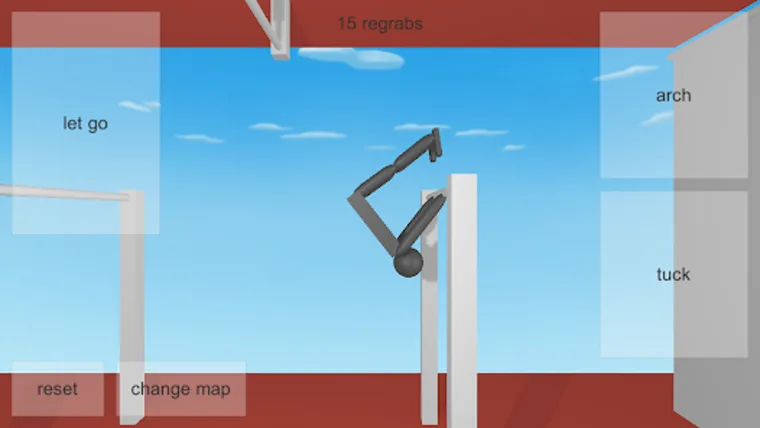
The Google Play and App Store listings describe a touch version with labelled zones — let go, arch, tuck and reset — plus a change map zone and an on-screen counter showing regrabs. That counter is the most useful thing here: it turns "I felt like I had a decent run" into a number you can compare between sessions.
Everything else on this page still applies, because the drill is about a repeatable shape rather than about a device. These are described in the store listings only; the browser build does not show a regrab counter and does not document a map-change input.
See which build you are playing if you are unsure, and tracking progress on mobile if you want the counter to mean something over weeks.
Keep a ten-minute swing log
The cheapest improvement in this game is a note. Ten minutes, six attempts, one line each:
- How the swing felt, in one word: high, flat, fast, stiff.
- Where you released relative to your normal moment: early, on time or late.
- What happened next: caught, missed, undershot, overshot.
After ten attempts you usually find one pattern — for example, that every late release lands short regardless of the swing. That single line is worth more than a hundred unstructured attempts, because it tells you which single variable to change next session.
Where to take this next
When three attempts in a row share the same swing and you can name the difference between an early and a late release without guessing, two things become possible: choosing a release on purpose, and reaching the next bar. If the swing is still unstable, go back to the start drill rather than forward — everything later is built on this repetition.
Browse the full set from all NoomiClone guides, or play the browser build from the developer’s listing page. Mobile features are described in the Google Play and App Store listings.
Frequently asked questions
How do you fix bad timing in NoomiClone?
Most timing complaints are really repeatability complaints. Fix the start of every attempt first, then change one variable per pair of attempts, then compare three releases from the same swing. If the swing changes every time, there is nothing to compare against and the release is not the problem.
How long should a NoomiClone swing practice take?
Ten minutes is enough for a swing log. The drill works because each attempt has the same starting point and one change, so the log becomes readable after a few entries. Longer sessions help less than short repeated ones.
What should I watch while swinging in NoomiClone?
Watch the same part of the swing every time rather than the whole motion. The guide covers what to actually watch so you can recognise the release point in the half second before your fingers decide anything.
Does the mobile build change swing timing practice?
It does not change the method, but it does change the inputs. The mobile build ships extra features and the browser build documents only four keys, so the drill is written for the classic browser build and labelled as such.
Sources and scope. Browser key bindings and mobile feature descriptions were checked against the developer's browser listing, Google Play and App Store on October 19, 2026. Practice drills are independent editorial suggestions. Game screenshot provenance is documented in About & sources.