What the browser build is
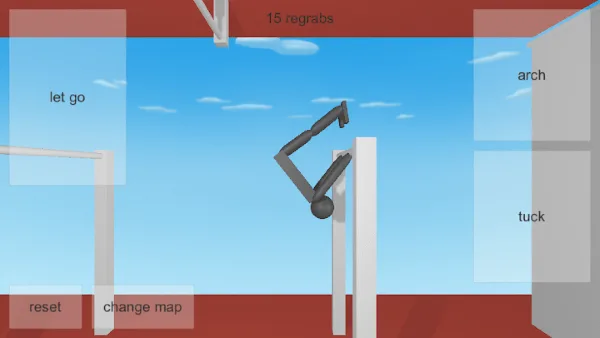
NoomiClone is a physics-driven gymnastics and parkour game. A ragdoll gymnast hangs from bars, swings on their own momentum, and responds to four keys: ← to arch, Space to tuck, ↑ to let go and R to reset. That is the documented control set for the classic HTML5 build, and it is what this guide uses.
Two things follow from that, and they shape everything else:
- The swing runs itself. You are not driving the gymnast around; you are shaping a body that is already moving.
- There is no grab key. Reaching a bar is the outcome of a release you set up, not an input you make at the catch.
If you are coming from the phone apps, note that the apps add touch zones, map changes and extra features described in the store listings. The version comparison explains what is different.
Before you touch a key
Spend thirty seconds on setup, because the first five minutes of practice are wasted if the game is not actually receiving your presses.
- Open the game and click once inside the playing area. Arrow keys scroll the page when the canvas does not have focus.
- Use a reasonably wide window. The bars are spaced for a landscape view, and a narrow window changes how much of the next bar you can see.
- Find a low bar to start on. Early practice should cost you a reset, not a run.
- Decide now that R goes between every attempt. Without it you cannot tell an improvement from a different start.
Once the gymnast is hanging and you have clicked the game area, you are ready. Full setup help for a blank or unresponsive game is in the PC setup guide.
First move: arch and watch
Before you try anything clever, hold ← from a hang and watch what the body does. That is the whole first exercise. You are building an observation, not a trick.
Watch three things: how the body changes shape, how the swing direction responds a moment later, and how far the gymnast travels before the swing comes back. Write your read in one sentence. "Arching makes the swing carry further" or "arching made the gymnast pull away from the bar" are both useful notes. "Arching is good" is not.
Then reset and do it four more times. If your sentence still holds, you have a reliable read on the key. If it changes every attempt, the swing is not settled when you start, and waiting for a still hang before you press is the fix.
Second move: tuck through the low point
Now put Space into the same swing. Try tucking once, roughly where the gymnast passes through the bottom of the arc, and compare it with the arch-only runs.
Compare the two directly:
- Does the gymnast travel further, or less?
- Does the change of shape happen sooner or later?
- Does the swing come back to the same place, or somewhere new?
Repeat the pair at least five times before you trust either answer. Then try tucking at a deliberately different point in the swing and see whether the difference is consistent. If it is, you have your first real timing variable, and it is one you can practice deliberately. The swing timing drill turns that variable into a repeatable routine.
Third move: a swing you can repeat
This is the step most beginners skip, and it is the one that makes everything else possible. Goal: three consecutive attempts from the same starting bar that look alike from the outside.
- Reset, wait for the hang to settle, run the same arch and tuck in the same places.
- Release nowhere near the next bar yet. Let go over open space where a miss costs nothing, purely to watch the flight.
- Reset and repeat twice more.
- Compare the three. Look at where the gymnast was when the arch started, and where they were when they let go.
If the three differ, do not change three things at once. Change the one that varies most, and only that one. This is slower than mashing inputs and far faster than mashing inputs, because you end up with knowledge instead of noise.
Fourth move: let go and read the flight
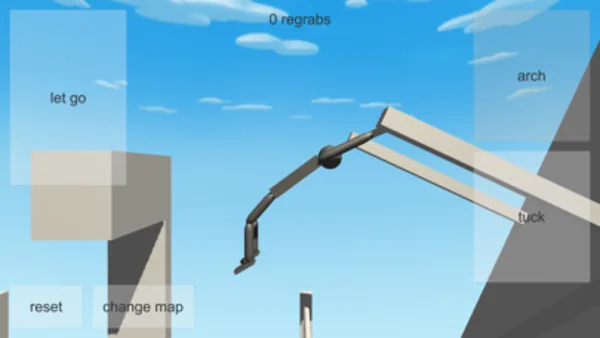
From that repeatable swing, press ↑ and then stop touching the keyboard. The gymnast is in free flight and nothing you press will change it until the body reaches a bar or the floor. That makes release the only decision left.
Read the flight in this order: where the gymnast was when they let go, where the travel peaked, and how they arrived at the target bar. Do this three times. Then release once slightly earlier and once slightly later, and watch the same three things.
You are looking for a direction, not an answer. Sometimes earlier carries more distance, sometimes later does, and which one is true depends on the swing you built. Because there is no grab key, the flight is the catch, so the more precisely you can describe the flight, the closer you are to reaching something. The release timing guide handles the comparison method in more detail.
Fifth move: the first regrab attempt
Now aim at a real bar with the same swing you already trust. Do not add a flip, and do not change two variables at once.
- Build the swing you can already repeat.
- Aim at one bar and pick one thing to adjust from your earlier comparison: release earlier, or release later.
- Reset and try again, changing only that.
- Keep the release that gets the gymnast nearest the bar, then try the catch again from that setup.
Your first catch will probably not be clean, and that is fine. What matters is whether it becomes more likely. Three attempts from one setup tell you more than ten attempts from five setups. When the catch starts working, the regrab guide covers diagnosing the misses, and falling recovery covers what to do when the run ends badly.
Where a first session goes wrong
| What you see | What to try |
|---|---|
| The gymnast never really swings | Reset, wait for a settled hang, then arch. Timing the press to the swing matters more than press length. |
| Every attempt looks different | Reset between attempts and change one variable at a time. |
| You let go too early every time | Release later from the same swing and compare the two flights. |
| You let go too late every time | Release earlier from the same swing and watch how much distance you lose. |
| You reach the bar but slip off | Keep the release timing and change only the body shape on the way in. |
| Nothing responds at all | Click inside the game area once. Focus, not controls: see the controls guide. |
What to read after the first swing
Once you have three repeatable swings and have read one flight properly, the next pages pay off in order:
- Swing timing — turning a repeatable swing into a consistent rhythm.
- Release timing — comparing earlier and later releases methodically.
- Regrabs — reaching the next bar and diagnosing a miss.
- Flips — adding rotation only once your release is predictable.
The first-session plan puts all of this into a fifteen-minute routine if you would rather follow a fixed schedule than explore.
Frequently asked questions
How do you play NoomiClone for the first time?
Start with one move at a time. Arch and watch the swing change, then tuck through the low point, then repeat the same swing until it feels repeatable, then let go and read the flight. The path from there is the first regrab attempt. Nothing here depends on keys the browser build does not document.
What should I do before pressing a key in NoomiClone?
Click inside the game window so it has keyboard focus, then press one key and watch what happens. The most common first-session mistake is changing two things at once and losing track of which one changed the flight path.
Why is my first NoomiClone swing so hard to repeat?
A first swing changes because the starting lean, the height and the speed at the top all change between attempts. The fix is repetition rather than a new technique: reach the same part of the swing in the same shape often enough that you recognise it before your fingers decide anything.
What do I read after my first NoomiClone swing?
Read where the flight went, not whether it looked impressive. Did the release happen at the same point in the swing? Did the body shape match the previous attempt? The guide walks through the first session in five moves so each one has a single thing to look at.
Sources and scope. Browser key bindings and mobile feature descriptions were checked against the developer's browser listing, Google Play and App Store on October 19, 2026. Practice drills are independent editorial suggestions. Game screenshot provenance is documented in About & sources.